

Answer Engine Optimization, or AEO, is the practice of creating and structuring content so that search engines, AI assistants, and generative platforms can easily understand, retrieve, and cite it. While traditional SEO focuses heavily on ranking web pages in search results, AEO aims to position content as a reliable source for direct answers.
AI search tools synthesize information from multiple sources instead of simply displaying a list of links. They often favor content that provides clear explanations, demonstrates expertise, addresses search intent, and uses a logical structure. As a result, brands must optimize not only for keywords but also for entities, topics, questions, and factual accuracy.
A strong AEO strategy supports AI visibility across generative search experiences, conversational assistants, featured snippets, and other answer-driven platforms. It also improves the clarity and usefulness of content for human readers, making AEO a natural extension of modern content marketing.
Why AI Visibility Matters for Modern Brands
Consumers increasingly use AI search to compare products, research problems, summarize complex topics, and make purchasing decisions. When a brand is mentioned or cited in an AI-generated answer, it can earn awareness and credibility at an important point in the customer journey.
AI visibility is especially valuable because users may receive an answer without visiting multiple websites. If a company is absent from that answer, it could lose exposure even if its pages perform well in conventional organic search. Brands therefore need content that is discoverable in both traditional results and generative interfaces.
Consistent visibility can also lead to qualified AI traffic. Although referral volume from individual AI platforms may vary, visitors who click through after receiving a detailed answer often have a clear objective. This can benefit software companies, service providers, publishers, and affiliate marketing businesses seeking high-intent audiences.
How AEO Differs from Traditional SEO
Traditional SEO and AEO share many foundations, including technical accessibility, keyword research, authoritative content, links, and a strong user experience. The primary difference lies in how information is presented and retrieved. SEO typically targets rankings for specific queries.
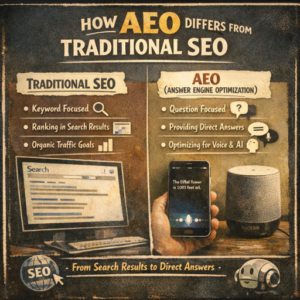
AEO focuses on making passages, definitions, comparisons, and recommendations easy for an answer engine to extract and interpret. This requires concise responses, well-defined entities, descriptive headings, contextual depth, and supporting evidence. AEO does not replace SEO.
Pages still need to be crawlable, indexable, fast, relevant, and trustworthy. However, success is no longer measured only by rankings and clicks. Brands must also consider citations, mentions, inclusion in generated answers, assisted conversions, and visibility across a broader range of AI search experiences.
How AI Search Engines Discover and Rank Content
AI search engines can discover information through search indexes, web crawlers, licensed datasets, retrieval systems, trusted databases, and other approved sources. The exact process differs by platform, and not every AI model retrieves live web content for every response. When retrieval is used, systems attempt to identify sources that are relevant, understandable, credible, and appropriate for the query.
Clear topical relationships help these systems connect a page with the user’s question. Original research, expert commentary, transparent sourcing, and current information can strengthen a page’s usefulness.
Technical SEO remains essential. Important content should be available in indexable HTML, supported by sensible internal links, and protected from accidental crawling or indexing restrictions. Performance, mobile usability, canonicalization, and a clean site architecture also influence whether content can be found and evaluated efficiently.
Optimizing Content for ChatGPT SEO and Generative Answers
ChatGPT SEO is an informal term for improving the likelihood that content will be discoverable, understood, and potentially referenced by conversational AI tools. It should not be treated as a separate ranking system with guaranteed positions. The practical goal is to publish useful information that retrieval-based tools can identify and trust.
Begin each important section with a direct response to the question implied by its heading. Follow that answer with context, examples, evidence, and practical guidance. This answer-first format gives AI systems a clear passage to retrieve while still providing depth for readers. Use precise language rather than vague marketing claims.
Define technical terms, distinguish facts from opinions, and include dates where freshness matters. Comparisons should use consistent criteria, while recommendations should explain who a product is for, its limitations, and why it was selected. These practices improve generative-answer readiness without reducing content to repetitive question-and-answer fragments.
Building Topical Authority to Increase AI Traffic
Topical authority develops when a website covers a subject comprehensively and demonstrates genuine expertise across related questions. A single page may rank for a narrow term, but a connected library of authoritative resources provides stronger evidence that the site understands the broader topic.
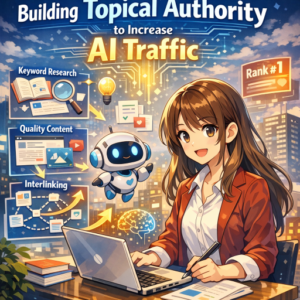
Create topic clusters around central themes. An AEO cluster, for example, could include AI search fundamentals, structured data, entity optimization, content design, measurement, and platform-specific research. Each supporting article should satisfy a distinct intent and link naturally to relevant cornerstone content.
Depth should not come from publishing near-duplicate pages. It comes from addressing meaningful subtopics with original insights and practical value. Case studies, proprietary data, expert interviews, templates, and tested processes can help content stand apart. Over time, this resource network may attract links, citations, branded searches, and qualified AI traffic.
Using Search Intent to Strengthen Your AEO Strategy
Search intent describes the goal behind a query. Common categories include informational, navigational, commercial, and transactional intent, but many AI conversations combine several objectives. A user might ask for an explanation, request a comparison, and seek a purchase recommendation within the same session.
An effective AEO strategy maps content to these stages. Informational pages can answer foundational questions, commercial pages can compare options, and transactional pages can help users select or buy a solution. The format should reflect the task: definitions need concise explanations, tutorials need sequential instructions, and product comparisons need consistent evaluation criteria.
Analyze search results, audience conversations, customer-support requests, community discussions, and on-site search data to understand intent. Avoid selecting keywords solely because they have high volume. A lower-volume query with strong relevance and commercial intent may generate more valuable organic traffic and affiliate conversions.
Creating Structured Content for Better AI Visibility
Structured content is easy for both people and machines to navigate. Every page should have a clear purpose, a logical hierarchy, and sections that answer focused questions.
Short paragraphs, descriptive headings, lists, tables, and summaries can make complex information easier to process. The opening section should quickly establish what the content covers and why it matters. Important definitions and recommendations should not be hidden behind lengthy introductions.

Each section should remain self-contained enough to make sense when extracted, while still contributing to the page’s broader narrative. Consistency is also important. Product reviews should follow a standard framework covering features, benefits, drawbacks, pricing, ideal users, and alternatives.
Educational articles should use consistent terminology and explain relationships between concepts. This semantic clarity increases AI visibility while improving accessibility and reader engagement.
Applying Schema Markup and Technical SEO for AEO
Schema markup provides explicit information about a page’s content and entities. Depending on the page, suitable types may include Article, Product, Review, Organization, Person, BreadcrumbList, VideoObject, or other schema supported by major search engines.
Markup must accurately represent visible content. For example, product ratings should not be added unless they are displayed and collected legitimately. Structured data does not guarantee inclusion in AI answers or rich results, but it can reduce ambiguity and help search systems understand relationships between authors, organizations, products, and pages.
Technical SEO should also ensure that valuable content is crawlable, indexable, mobile-friendly, secure, and fast. Use canonical tags correctly, repair broken internal links, maintain current XML sitemaps, and prevent important resources from being blocked unintentionally. JavaScript-dependent content should be tested to confirm that crawlers can access the final information.
Combining AEO and Content Marketing to Grow Organic Traffic
AEO works best when incorporated into a broader content marketing strategy. Instead of creating isolated articles for individual keywords, brands should build resources that answer audience questions throughout the buying journey. Research can begin with customer interviews, sales conversations, support tickets, keyword tools, search results, and competitor analysis.
These sources reveal common problems and language patterns. The resulting editorial plan should balance evergreen education, timely industry developments, commercial comparisons, and conversion-focused content. Distribution also matters. Promote high-quality resources through email, social media, digital public relations, professional communities, and partnerships.
Greater exposure can generate links, mentions, feedback, and branded demand. Updating successful pages with new evidence and improved answers can then sustain organic traffic more efficiently than continually publishing low-value material.
Leveraging AI Marketing Without Sacrificing Content Quality
AI marketing tools can support research, outlines, content briefs, data organization, editing, personalization, and performance analysis. They can increase efficiency, but they should not replace subject-matter expertise or editorial accountability. Generic AI-generated content often repeats familiar ideas, introduces unsupported claims, or fails to reflect real experience.
Every important article should therefore undergo human review for accuracy, originality, tone, legal risk, and usefulness. Sensitive topics may require review by a qualified professional. Use AI to accelerate repeatable tasks while reserving strategic decisions for experienced people.
Add first-party data, original examples, product testing, expert quotations, and specific recommendations. The objective is not to publish more content at any cost; it is to produce better content with a sustainable workflow.
Sean Haren